PHYSICS-DRIVEN
Transparent modelling built around ply-level behaviour and failure progression — not opaque burst-margin rules.
High-pressure propulsion systems occupy a uniquely difficult design space: they must safely contain extreme internal pressures while meeting aggressive mass targets, surviving thermal and mechanical cycling, and remaining manufacturable within real-world constraints. In rocketry, structural mass directly reduces performance — yet conservative margins are often applied because composite failure behaviour is complex and difficult to predict.
Composite Overwrapped Pressure Vessels (COPVs) offer exceptional pressure-to-weight performance, but they introduce a level of structural complexity that can’t be captured with thin-wall pressure vessel theory or a single “burst pressure” calculation. Laminates are anisotropic, non-homogeneous, and fail progressively rather than catastrophically. In practice this often leads to overbuilt designs, or reliance on high-fidelity FEA that is expensive to iterate and provides limited physical intuition early in the design process.
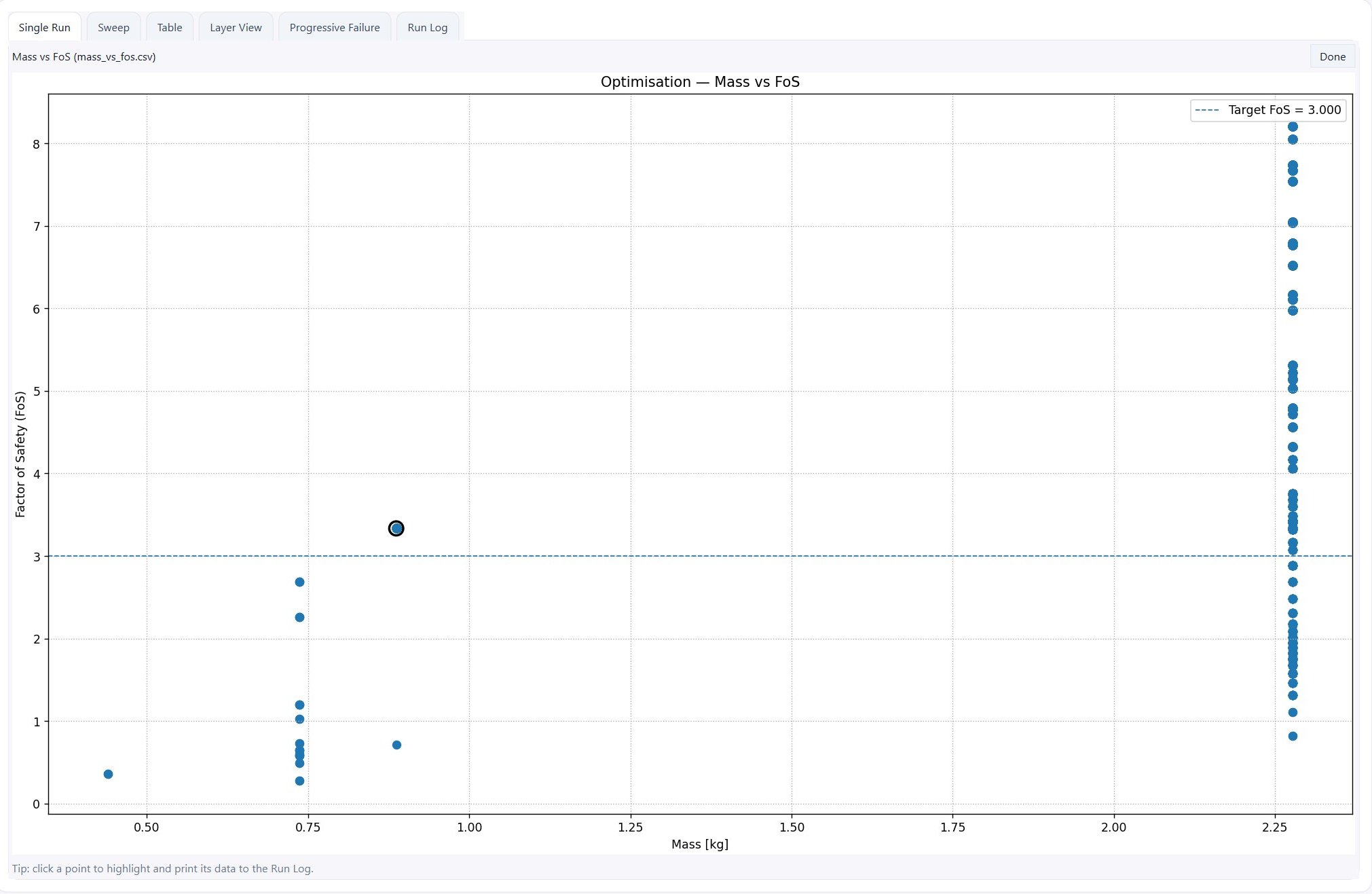
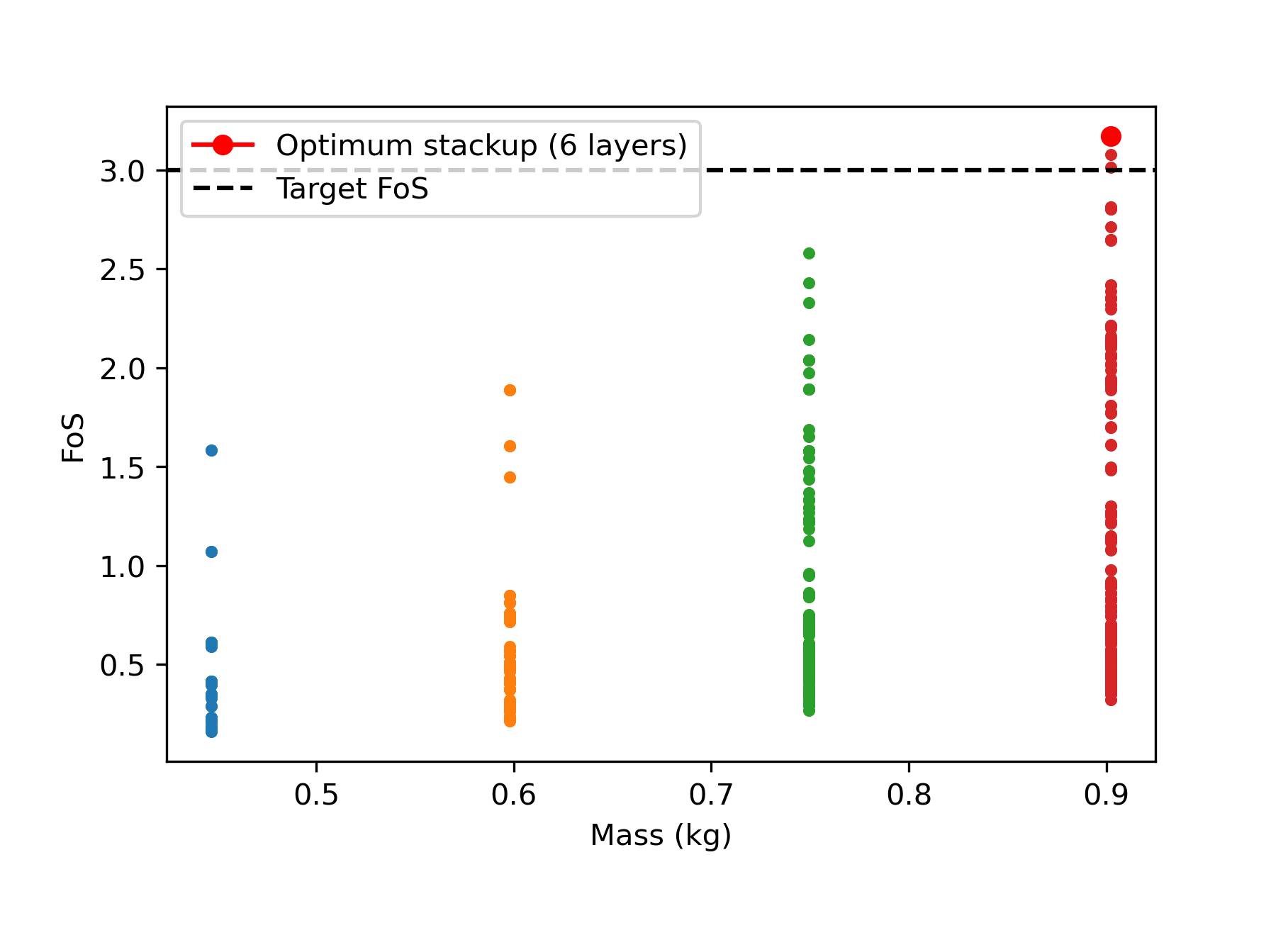
This project was undertaken to address that gap: I expanded an in-house layup analysis script originally written by Thomas Russell into a transparent, computationally efficient COPV solver capable of evaluating composite layups at the ply level, modelling progressive failure, and optimising mass vs. target factor of safety. It is not intended to replace high-fidelity FEA — it is a design-stage decision engine that enables rapid exploration of the design space while keeping a clear link between assumptions, physics, and results.
The solver is built to answer one deceptively simple engineering question:
What is the lightest composite pressure vessel that can safely survive a specified internal pressure with a defined margin against failure?
Achieving this requires more than a single stress calculation. It demands an understanding of how loads are distributed through a laminate, how individual plies contribute to stiffness and strength, how failure initiates, and how damage propagates as pressure increases. The solver explicitly addresses each of these aspects and outputs not only an “answer”, but the reasoning behind it.
Transparent modelling built around ply-level behaviour and failure progression — not opaque burst-margin rules.
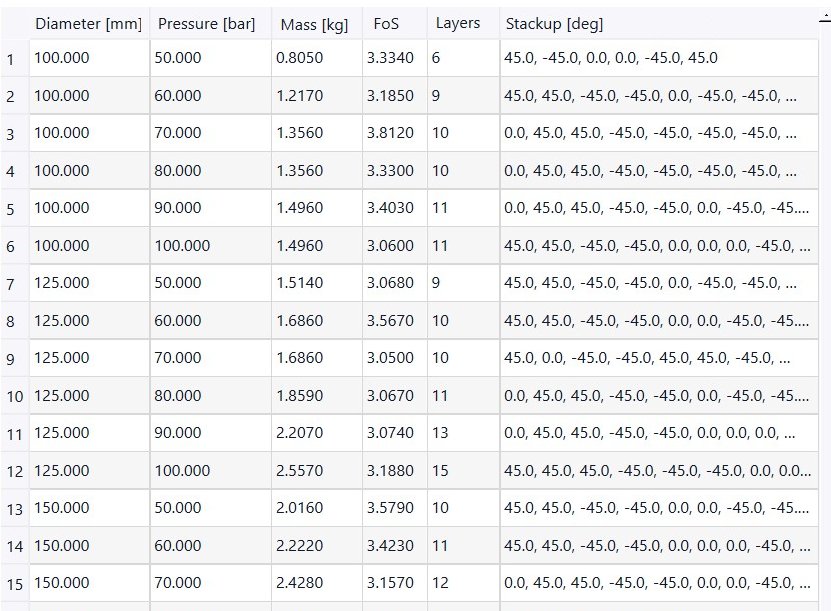
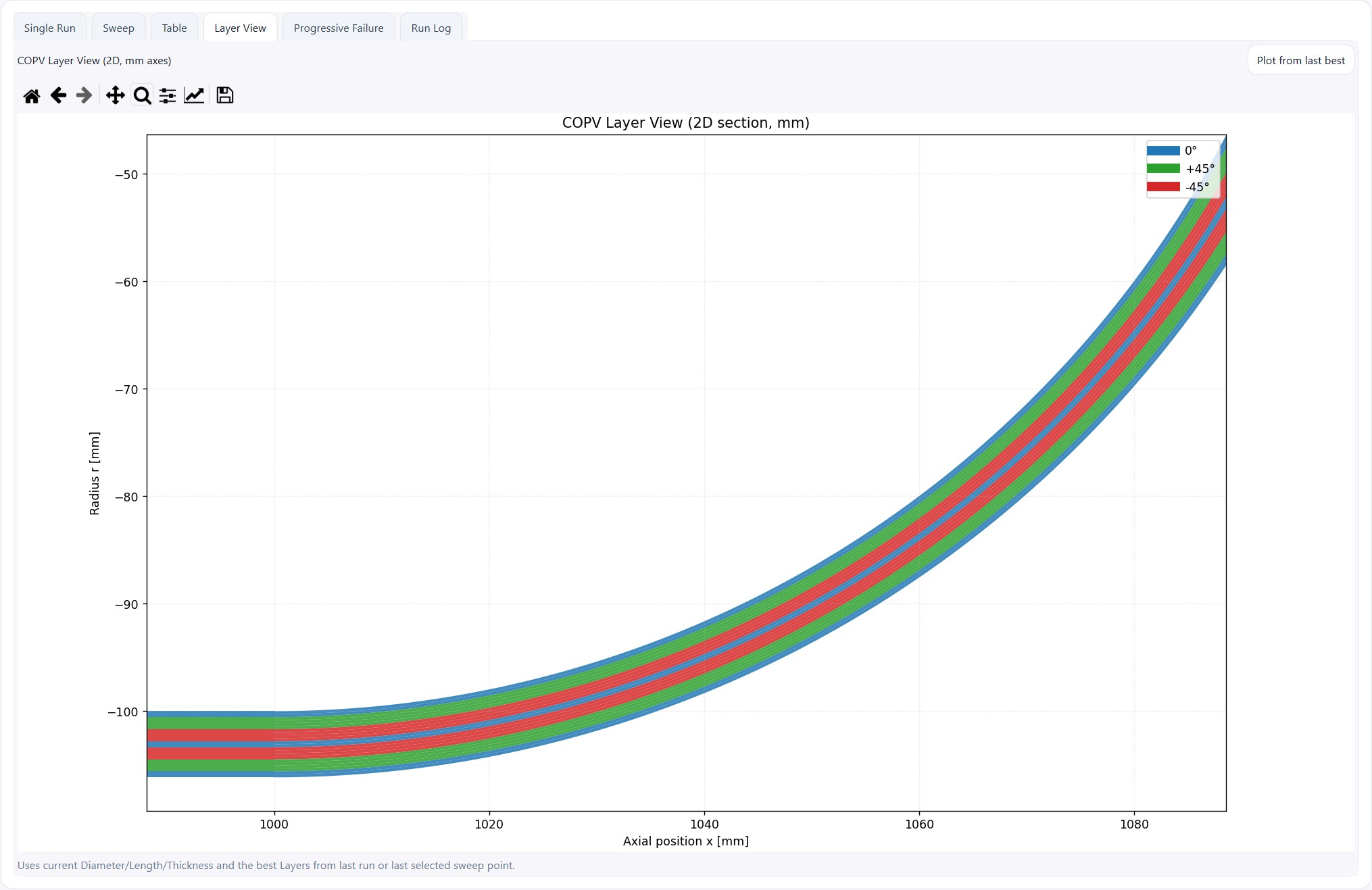
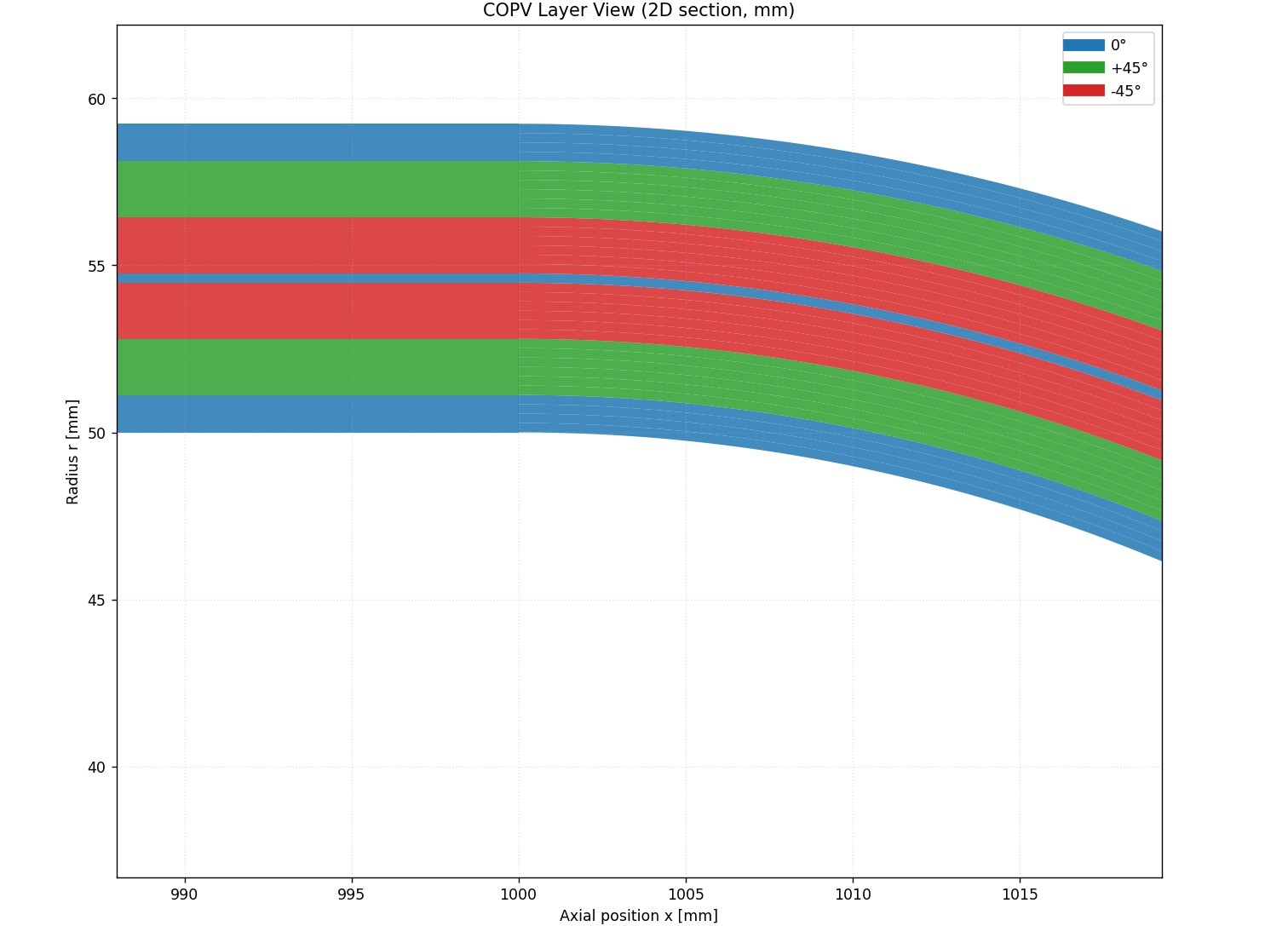
Finds the minimum-mass layup meeting a target factor of safety, with constraints aligned to real manufacturing.
Outputs failure initiation pressure, failure order, and redundancy — not just a single pass/fail number.
For a given internal pressure, the solver computes global hoop and axial loading and resolves these into ply-level stress states based on each ply’s orientation and material properties. This explicitly captures the structural reality that:
Rather than averaging stresses across the laminate, each ply is evaluated individually. This is a critical distinction: COPV failure is almost always initiated by the overstressing of a specific subset of plies, not uniform material failure through the entire thickness.
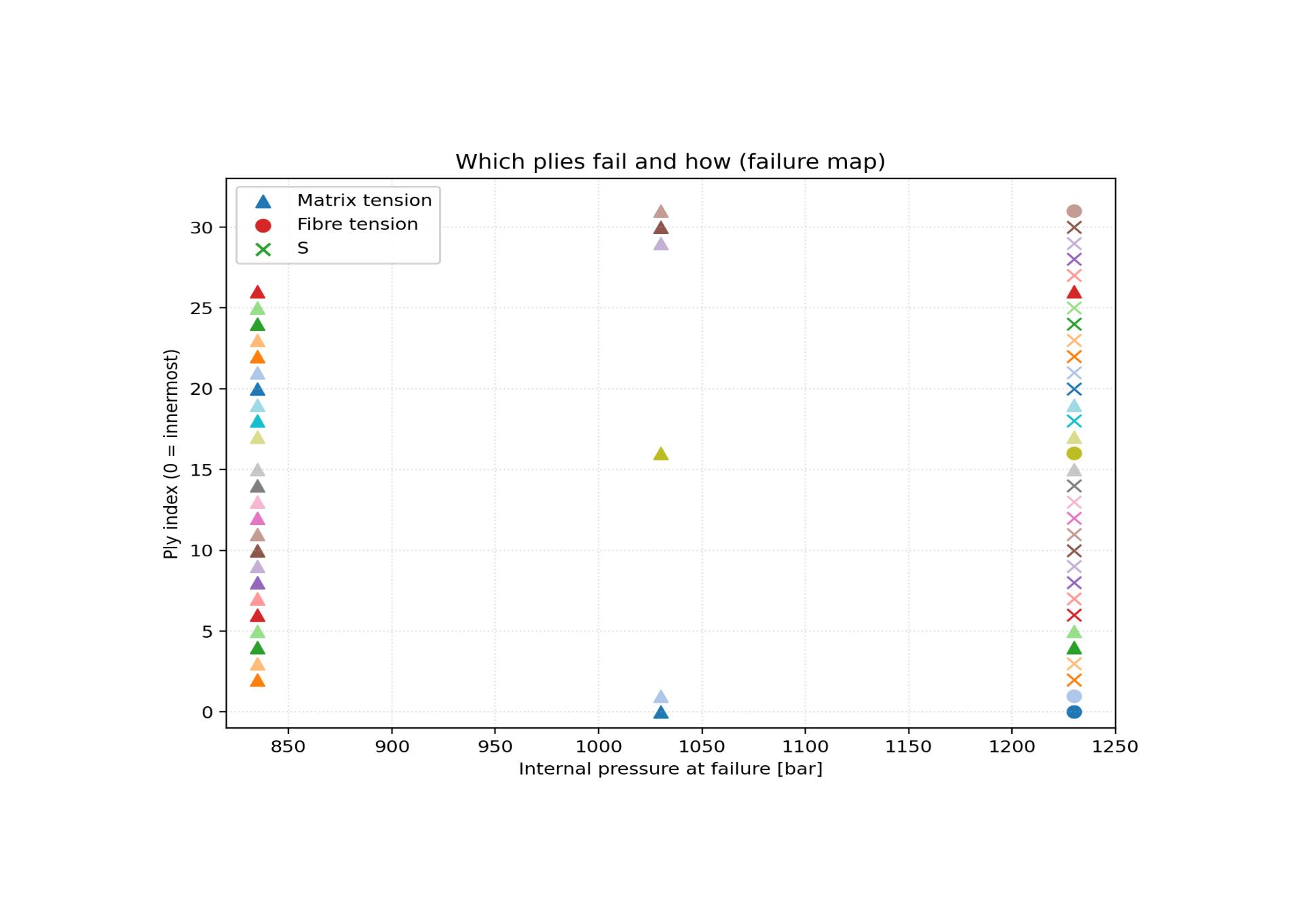
The defining feature of this project is its implementation of progressive failure analysis. In real composite pressure vessels, failure does not occur instantaneously when the first ply reaches a strength limit. Instead, damage initiates locally, stiffness is reduced, and load redistributes to neighbouring plies. This continues incrementally until the remaining structure can no longer sustain the applied load.
The solver captures this behaviour explicitly. Internal pressure is increased in controlled increments. At each increment, every ply is evaluated against its failure criterion. When a ply fails, its stiffness contribution is removed or degraded, and subsequent increments reflect physically realistic redistribution of load.
This produces outputs that simpler approaches cannot:
Two layups can appear equivalent when judged only by ultimate burst pressure, yet behave radically differently once progressive damage is considered. This is exactly the kind of nuance that matters when trying to reduce mass safely.
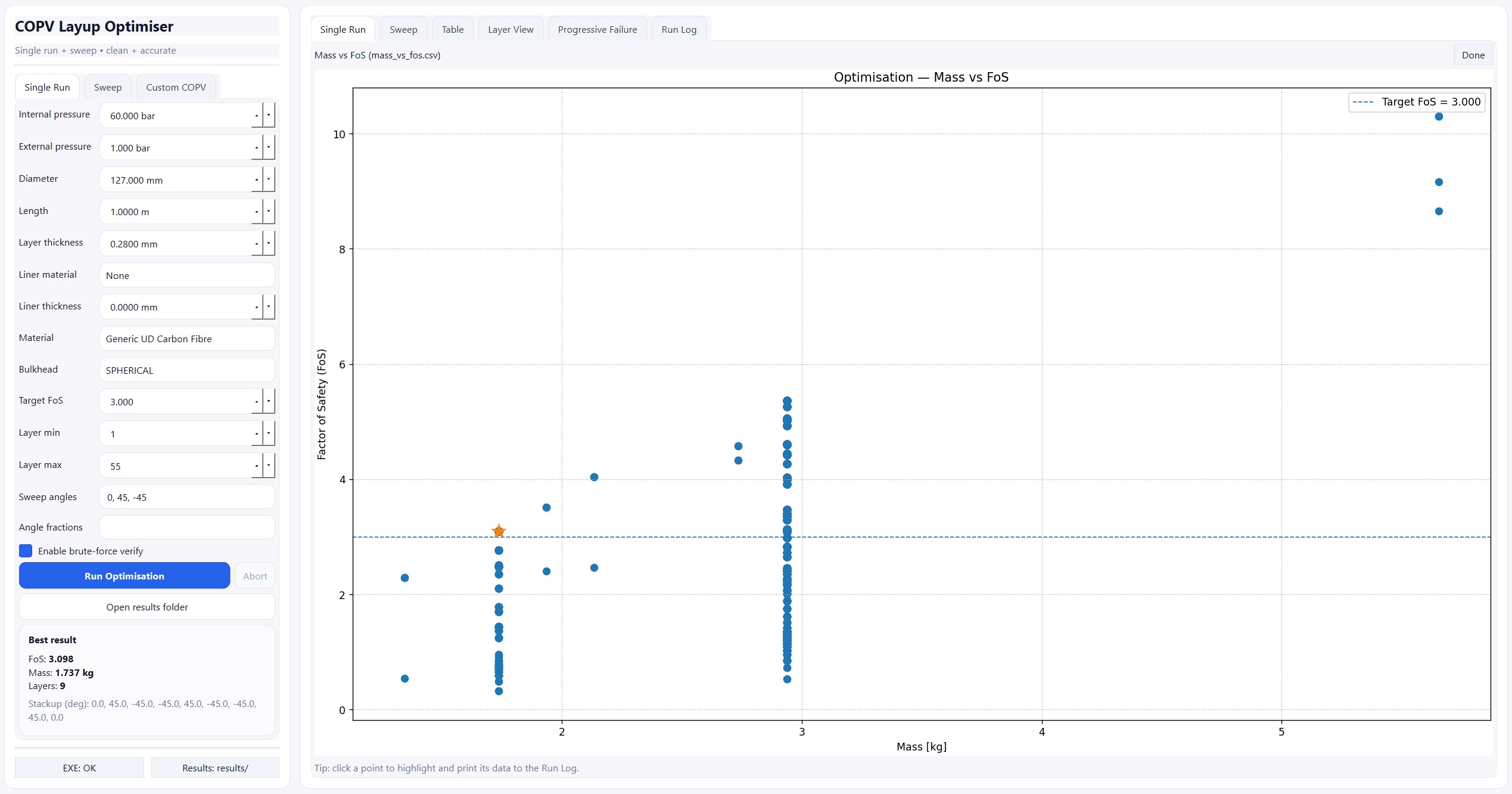
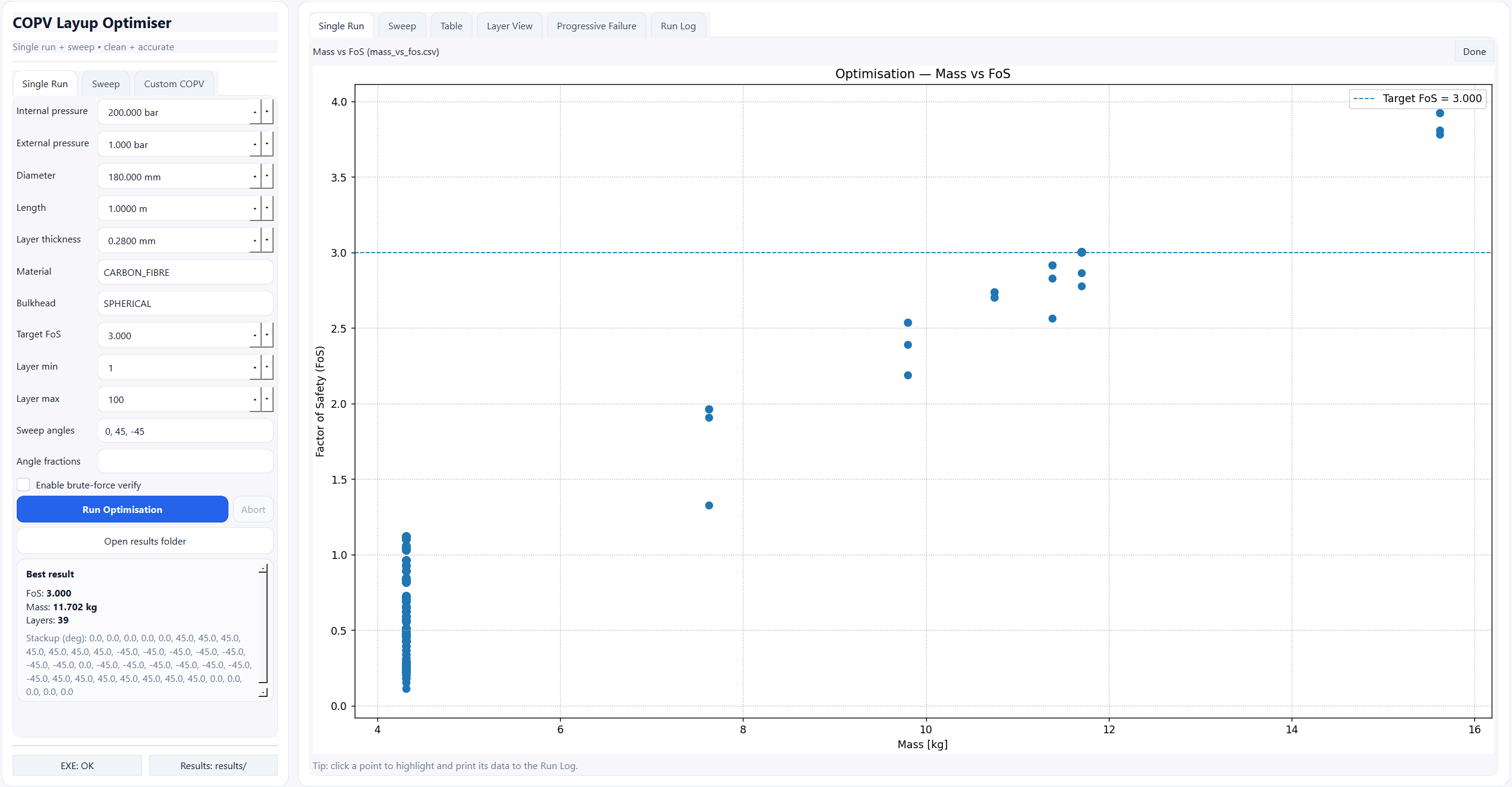
On top of the structural solver sits an optimisation framework designed to efficiently search the design space. Rather than brute-forcing every possible layup, the optimiser uses a binary search strategy to determine the minimum number of plies required to meet a specified factor of safety.
For each candidate layup size, the solver evaluates whether the vessel survives the target pressure without unacceptable failure progression. Mass is computed directly from ply count, thickness, and material density — ensuring optimisation decisions are grounded in physical reality.
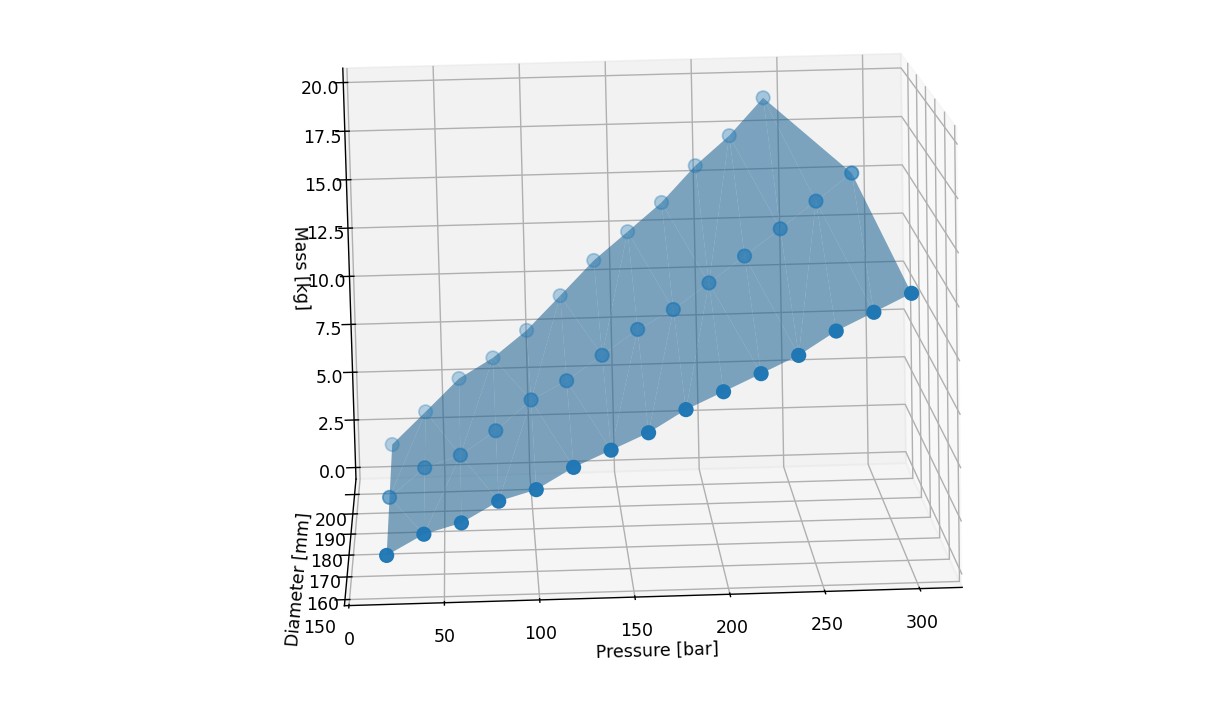
This approach converges quickly while remaining robust to non-linearities introduced by progressive failure. It also enables fast parametric sweeps across pressure, diameter, material systems, liner thickness, and angle distributions with minimal computational overhead.
This project represents a shift away from black-box structural analysis toward a transparent, physics-driven design methodology.
It treats composite pressure vessels not as monolithic components, but as evolving structures whose behaviour can be understood, predicted, and optimised.
By combining progressive failure modelling with efficient optimisation, the solver enables smarter engineering decisions at the stage where they matter most.
It stands as both a practical design tool for propulsion hardware and a demonstration of rigorous structural engineering thinking applied to real constraints.